Veterinary Answering Service: Who Answers Your After-Hours Calls?
09/29/2026
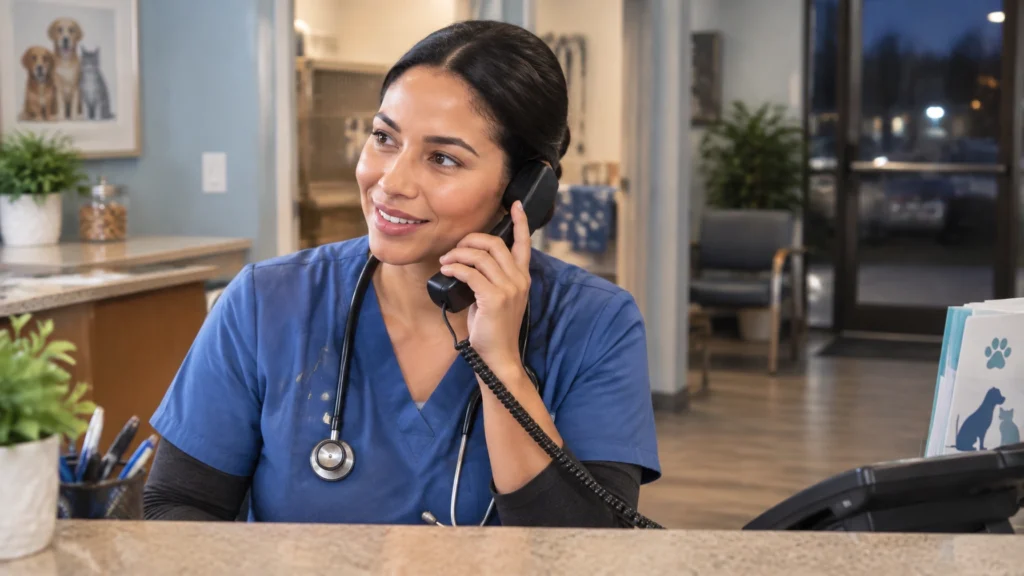
Every veterinary practice depends on clear communication, but phone coverage becomes harder the moment your front desk closes. That challenge is especially urgent for practices serving clients at night, on weekends, during holidays, or while the team is already handling a full daytime schedule.
When an owner calls after hours, the person who answers represents your practice. If the call reaches voicemail, a rotating personal cell phone, or an operator who improvises, your team may lose trust before anyone has a chance to help. The result can be missed appointments, incomplete messages, unnecessary interruptions, and confusion about what happens next.
So who answers your after-hours calls?
With the right veterinary answering service, a trained US-based operator answers in your practice’s name and follows the written process you approve. The operator does not assess an animal, diagnose a condition, or decide independently whether a situation is an emergency. Your practice’s protocol determines the next step.
Your written protocol should lead the conversation
A reliable after-hours process starts with one simple principle: your practice sets the rules.
Your team decides:
- How callers should be greeted
- What information the operator should collect
- Which routine calls should become messages for the next business day
- Which calls should be routed to your on-call DVM
- How many contact attempts should be made
- What happens if the first on-call contact does not respond
- Which emergency hospital your practice has nominated
- How messages should be delivered and documented
The operator follows that process without adding personal judgment. If the caller describes something covered by your approved protocol, the operator reads back the appropriate instructions and routes the call as directed. If the situation is not covered, the call escalates according to your backup rules rather than receiving an improvised answer.
That distinction matters. Talk is cheap, but a process has to walk the walk when the phone rings at 2:00 a.m.

What does a veterinary answering service operator actually do?
The operator’s job is to provide a consistent, professional handoff. That usually involves four essential responsibilities.
1. Answer in your practice’s name
The conversation should begin with your approved greeting, not a generic call center introduction. Your clients should know they have reached the correct practice and that their call is being handled according to your instructions.
For a general small-animal practice, that may mean confirming the practice name and explaining that the team is handling after-hours calls. For a multi-location group, the operator may also confirm the relevant location before continuing.
2. Capture the information your team needs
Your practice determines the required fields. Depending on your workflow, the operator may collect:
- Caller name and best callback number
- Animal’s name and species
- Whether the caller is an existing client
- The reason for the call in the owner’s own words
- The caller’s preferred location or regular veterinarian
- The requested next step
- Any timing details your written protocol requires
The operator is not interpreting the information or turning it into clinical advice. The goal is to record it accurately so the right person can respond.
3. Follow your routing instructions
A veterinary answering service should not use a one-size-fits-all process. Your practice may want appointment requests and refill messages sent to the daytime team, while other calls follow an on-call escalation path.
Your instructions may specify:
- First contact: the on-call DVM
- Waiting interval before a second attempt
- Backup contact if the first DVM does not answer
- Final escalation to the emergency hospital you nominate
- Message delivery by phone, text, email, secure app, or another approved method
The exact sequence belongs to your practice. A dependable service carries it out consistently.
4. Close the call with a clear next step
A caller should not finish the conversation wondering what happens next. The operator should communicate the outcome your practice has approved, such as:
- A message has been sent to the daytime team
- The on-call DVM is being contacted
- A second escalation attempt will occur after the interval you set
- The caller should contact the emergency hospital named in your protocol
- An appointment request has been recorded for follow-up
Clear expectations reduce repeated calls and help your staff understand what has already happened.
Why after-hours coverage is difficult for veterinary teams
Veterinary practices often have several types of phone traffic competing for attention. A general practice may receive appointment requests, refill questions, boarding inquiries, records requests, and follow-up messages. Emergency and specialty hospitals may handle higher call volume and more complex routing requirements. Mobile and house-call veterinarians may need calls directed to a changing schedule or service area.
Equine and large-animal practices face their own operational challenges, including wide service areas and fewer available contacts. Multi-location groups need consistent greetings, location-specific instructions, and reliable delivery to the correct team.
Trying to manage every call internally can create problems:
- The same staff member carries the phone every night
- On-call DVMs receive routine calls that could have waited
- Important messages arrive without enough information
- Callers receive different answers depending on who is covering
- Personal numbers become part of the practice’s informal workflow
- There is no consistent record of contact attempts
When working in a busy veterinary environment, your team needs a system that protects both availability and boundaries. A professional after-hours answering service gives your practice a defined process without requiring your daytime staff to remain on the phone around the clock.

Use these tips to build a safer call-handling process
Before coverage begins, use these tips to make your instructions specific and easy to follow:
- Write the escalation path in order. List who is contacted first, how long the operator waits, and who receives the call next.
- Separate routine and on-call traffic. Identify the calls that should become messages for the next business day.
- Name the emergency hospital. Include its current name, address, phone number, and any approved wording the operator should use.
- Define what happens when information is missing. Tell the operator when to make another attempt, send a message, or escalate.
- Create location-specific instructions. Multi-location groups should identify the correct practice, contact, and destination for each call.
- Review your script regularly. Update the protocol when staffing, hours, contacts, or referral arrangements change.
- Test the process before launch. Place routine and escalation test calls to confirm that every step works as expected.
- Request clear documentation. Make sure your team can review messages, timestamps, contact attempts, and outcomes.
- Protect sensitive information. Establish how information is collected, stored, and delivered according to your practice’s requirements.
- Tell callers what to expect. Your website, voicemail, and client communications should describe the after-hours process accurately.
The Golden Rule applies here: give callers the clarity and respect you would want if you were trying to reach a business after closing. A calm greeting, accurate message, and clear next step can make a lasting difference.
Who benefits from this kind of coverage?
A veterinary answering service can support more than one practice model.
General small-animal practices
Keep routine requests organized after closing while sending calls that meet your written criteria through the correct escalation path.
Emergency and specialty hospitals
Manage call volume with consistent intake and routing instructions, especially when multiple departments or contacts are involved.
Mobile and house-call veterinarians
Make sure callers reach a live person even when you are driving, with instructions that reflect your schedule and service area.
Equine and large-animal practices
Provide a dependable point of contact when your team is traveling between appointments or covering a broad geographic region.
Multi-location groups
Standardize greetings and workflows while routing calls to the right location, team, or on-call contact.

The person answering matters
Technology can record a message, but it cannot replace a well-designed human handoff. A live operator can listen carefully, confirm information, follow your approved wording, and explain the next step without forcing callers through an endless menu.
That does not mean the operator replaces your veterinary team. It means your team can focus on the work only it can do while every caller receives a consistent first point of contact.
The best service relationship is collaborative. Your practice supplies the knowledge, boundaries, contacts, and escalation instructions. The answering team applies them consistently, documents the interaction, and helps you identify where the process needs improvement.
Choose coverage built around your practice
The right question is not simply, “Does someone answer the phone?”
Ask instead:
- Does the service follow our written protocol?
- Are operators prohibited from providing clinical advice?
- Can we define our own escalation intervals?
- What happens if the on-call DVM does not respond?
- Can we nominate the emergency hospital?
- Are messages delivered through the channels our team uses?
- Can we update scripts when our workflow changes?
- Will the same standards apply during nights, weekends, holidays, and daytime overflow?
Your practice deserves answers that are specific, documented, and workable. If after-hours calls are currently landing in voicemail, interrupting your DVMs, or creating inconsistent experiences, now is a good time to review the process before the next busy period.