Why the First Restoration Company to Answer Usually Wins the Job
10/01/2026
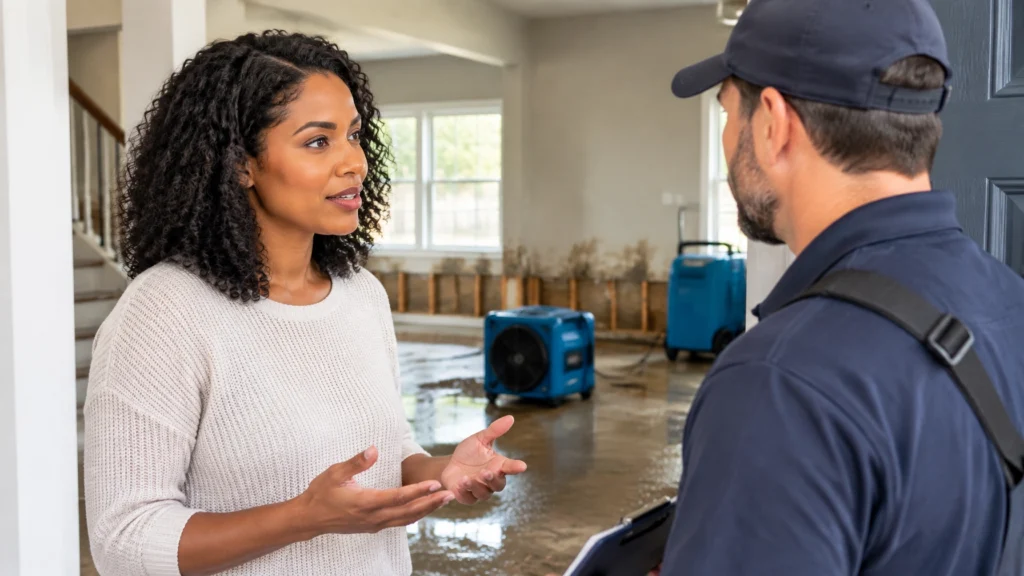
In restoration, speed is more than a customer-service advantage. It is often the difference between winning the job and hearing nothing after the first ring.
A homeowner with active water, smoke damage, or storm-related destruction is rarely calling one contractor and waiting patiently. They are calling down a list. If your competitor answers with a real person while your caller reaches voicemail, the opportunity may be gone before your team sees the notification.
That is why restoration contractors need a reliable process for answering, qualifying, and escalating urgent calls. The goal is not to make promises your crews cannot keep. The goal is to give every caller a clear next step while your on-call team receives the details needed to respond.
Why the first live answer matters
Picture a homeowner standing in a flooded kitchen at 2 a.m. Water is spreading across the floor, a ceiling is stained, or a storm has torn away part of the roof. They may not know which restoration company to trust, but they know one thing: they need help now.
They call the first company. No answer.
They call the second. A real person picks up, listens, gathers the details, and explains that a technician is being contacted. That company has immediately created confidence and momentum.
The homeowner may still speak with another contractor, but the first live answer has a major advantage. The conversation has moved from “Who can help?” to “What happens next?”
For restoration businesses, that first connection can protect:
- Water and flood restoration leads
- Fire and smoke damage projects
- Storm-response opportunities
- Mold remediation inquiries
- Board-up and emergency-tarping calls
- Biohazard and trauma cleanup requests
- Referrals from property managers, carriers, and other contractors
Talk is cheap, but a live answer that leads to a documented next step helps your company walk the walk.
The first call is about intake, not improvisation
A strong restoration call process does not require the operator to diagnose damage, estimate the project, or make technical decisions. It requires the operator to gather the information your team has identified as important and follow your escalation instructions accurately.
A homeowner may say, “There is water everywhere.” That description is urgent, but your on-call technician needs more context.
A well-designed script can capture:
- The caller’s name and best callback number
- The property address and access instructions
- The type of loss, such as water, fire, smoke, storm, mold, or sewage
- When the incident started
- Whether water, fire, smoke, or another active condition is still present
- The affected rooms, floors, or areas
- Whether power and water are on
- Access concerns, occupants, pets, or security considerations
- Insurance carrier, claim number, adjuster, or policyholder information when available
- Any referral or program details your business requires
This information gives your crew chief or on-call technician a useful starting point. It also reduces the risk that your team spends the first callback repeating basic questions while the caller waits for direction.

Five ways your answering process can win more restoration jobs
1. Make every urgent call reach a real person
A voicemail greeting cannot reassure a homeowner whose basement is filling with water. An automated menu cannot explain what happens next. In a time-sensitive situation, a human voice establishes contact immediately.
Your restoration answering service can provide live coverage for water damage contractors, fire and smoke specialists, mold remediation teams, storm crews, and other restoration companies that receive calls outside normal office hours.
The objective is straightforward: reduce the number of callers who hear silence, wait for a callback, and move on to another contractor.
2. Use a script built around your operation
Every restoration company has different service areas, programs, on-call contacts, escalation intervals, and criteria for waking a technician. A generic script will not reflect how your business actually operates.
Use these tips when building your call flow:
- Define which types of calls require immediate escalation.
- List the questions operators should ask before contacting your on-call team.
- Specify which details are required and which are optional.
- Identify the primary contact, backup contact, and final escalation point.
- Establish how many attempts should be made and at what intervals.
- Explain how routine calls should be delivered during business hours.
- Update the script whenever your service area, staffing, or response protocol changes.
The Golden Rule applies here: treat the caller the way you would want your own family member treated during a property emergency. Be calm, clear, respectful, and honest about what you know.
3. Work the escalation path to its end
Contacting one technician and leaving a voicemail is not the same as dispatching according to your instructions.
What happens when your primary on-call person is driving, asleep, already handling another loss, or outside coverage? If the call stops there, your company may lose the opportunity even though the answering agent technically responded.
A dependable escalation process keeps moving:
- The operator gathers the required information.
- The primary on-call contact is reached according to your instructions.
- If there is no answer, the next contact is attempted.
- The process continues through the backup list.
- Each attempt is documented with the relevant time and outcome.
- The caller receives a truthful update about what is happening next.
Your operators should not invent a result. They should not say a technician is on the way unless your team has confirmed it. They should say what is true: the information has been captured, the on-call contact is being reached, and the caller will receive a callback according to your process.
4. Keep promises within your team’s control
Restoration customers want certainty, but your answering process must not create commitments your field team cannot meet.
Operators should never:
- Quote the cost of the work
- Estimate the size or scope of the loss
- Diagnose the cause of damage
- Guarantee insurance coverage
- Promise a technician’s arrival time without confirmation
- Commit a crew to a window that your operations team has not approved
This boundary protects your customer, your staff, and your reputation.
A caller is better served by a precise and honest statement than by an attractive promise that falls apart later. For example: “I have documented the details and am contacting the on-call technician now. Someone from the restoration team will follow up with you.”
That statement is useful, professional, and keepable.
5. Prepare for storm-driven call volume
Storms create a difficult combination: more calls arrive while access, staffing, and field capacity become harder to manage.
A fixed office team may struggle to answer every line while your managers are coordinating crews and your technicians are already in the field. Missed calls accumulate quickly. So do competing contractors’ opportunities.
Coverage that scales during a storm event can help you:
- Keep emergency lines answered
- Capture consistent loss information
- Separate urgent escalations from routine messages
- Follow the same on-call process across a surge
- Support referrals from carriers, property managers, and program partners
- Give your internal team a clearer record of every contact
When working in restoration, your call process should be tested before the storm arrives, not while your phones are already ringing nonstop.

What does “first to answer” really mean?
Being first does not mean rushing a caller off the phone. It means being the first company to establish a credible, organized path forward.
That requires more than saying, “We can help.” Your answering process should help the caller understand:
- A real person has heard the situation.
- The important details have been recorded.
- The information is being sent through the correct escalation path.
- No one is making an unsupported estimate or arrival promise.
- The restoration team has a clear opportunity to follow up.
This approach creates a better handoff. It also shows callers that your business is prepared for the kind of urgent work it advertises.
How to tell whether your current process is costing you jobs
Ask yourself a few direct questions:
- Who answers your emergency line at 11 p.m.?
- What happens when your primary technician does not pick up?
- Can someone document whether water or fire is still active?
- Are operators asking about affected rooms, floors, power, access, and pets?
- Does your team receive the caller’s details in a consistent format?
- How quickly can you change the script before a major weather event?
- Do you know how many calls went to voicemail last month?
- Are callers receiving facts, or are they being given promises no one confirmed?
If the answers are unclear, your problem may not be lead generation. You may already be generating enough opportunities. The gap may be what happens between the incoming ring and the on-call response.
For restoration contractors, a professional emergency answering service can provide a structured first point of contact while your field team handles the work only it can perform. Your operators answer, gather the right information, follow your escalation list, and document the attempts. Your staff retains control over pricing, technical decisions, dispatch confirmation, and arrival commitments.

Turn the first call into the right next step
The first restoration company to answer usually wins because the caller is looking for immediate confidence, not a complicated sales presentation. A live person, a calm intake process, and a truthful next step can separate your business from the contractor whose phone keeps ringing unanswered.
Your team has enough to manage when a storm hits or multiple losses arrive at once. You should not have to wonder whether urgent callers are reaching voicemail, whether the right technician is being contacted, or whether a vague message is sitting unattended until morning.
If your restoration company needs dependable coverage for water, fire, storm, mold, biohazard, board-up, or contents-cleaning calls, contact CallCenterUSA to discuss a customized script, on-call escalation process, and 24/7 live answering coverage.